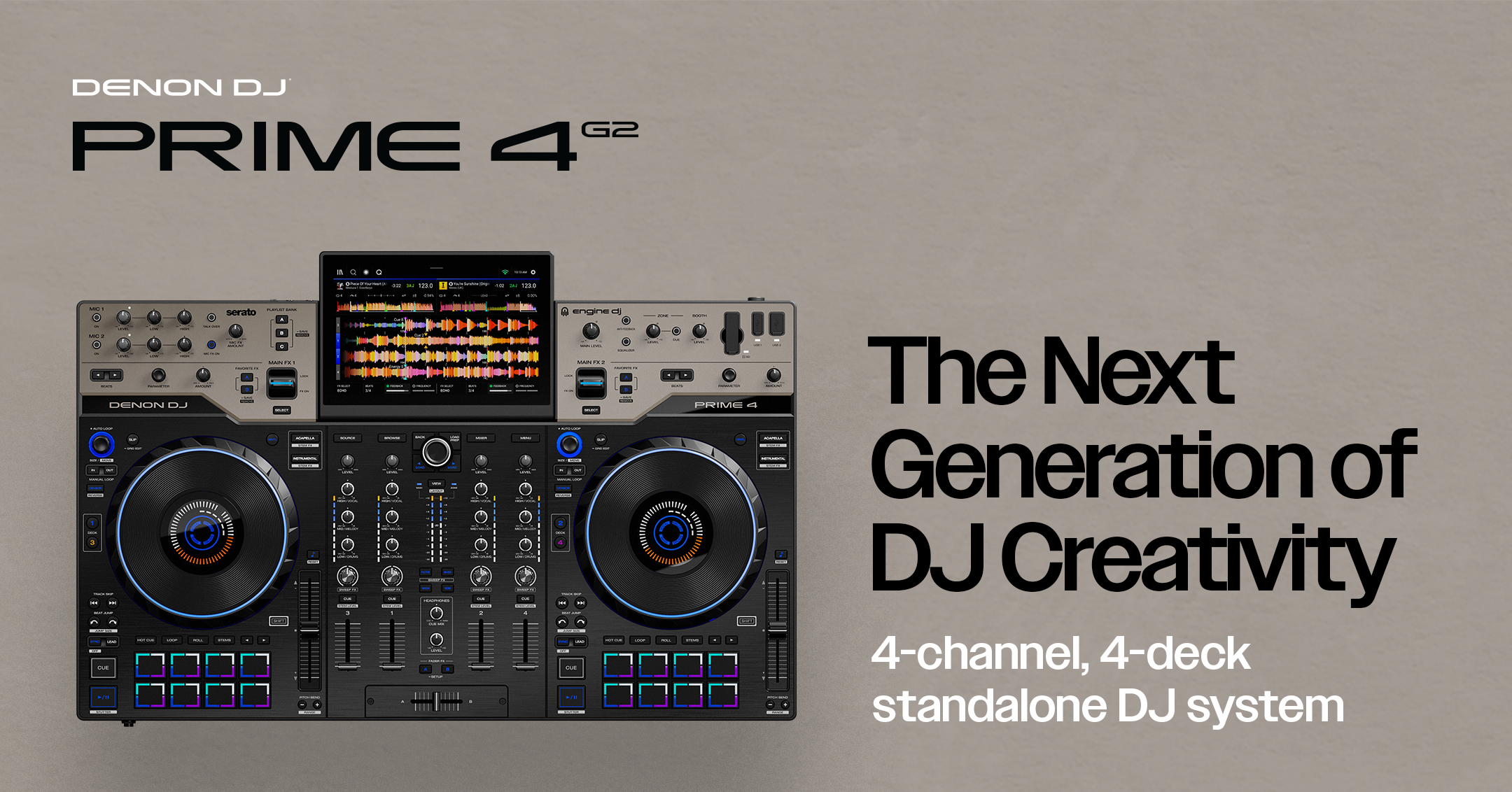
The original Denon DJ PRIME 4 helped redefine what DJs could expect from a four-deck standalone system. Now, the Denon DJ PRIME 4G2 pushes that concept into a new generation with more processing power, larger jog wheels, deeper Stems control, MPCe multi-zone performance pads, expanded FX, and built-in DMX lighting control.
This is more than a cosmetic refresh. Denon DJ has taken the standalone workflow that made the PRIME 4 popular with mobile and private-event DJs and added new ways to perform, mix, control lighting, and manage an entire event setup from one system.
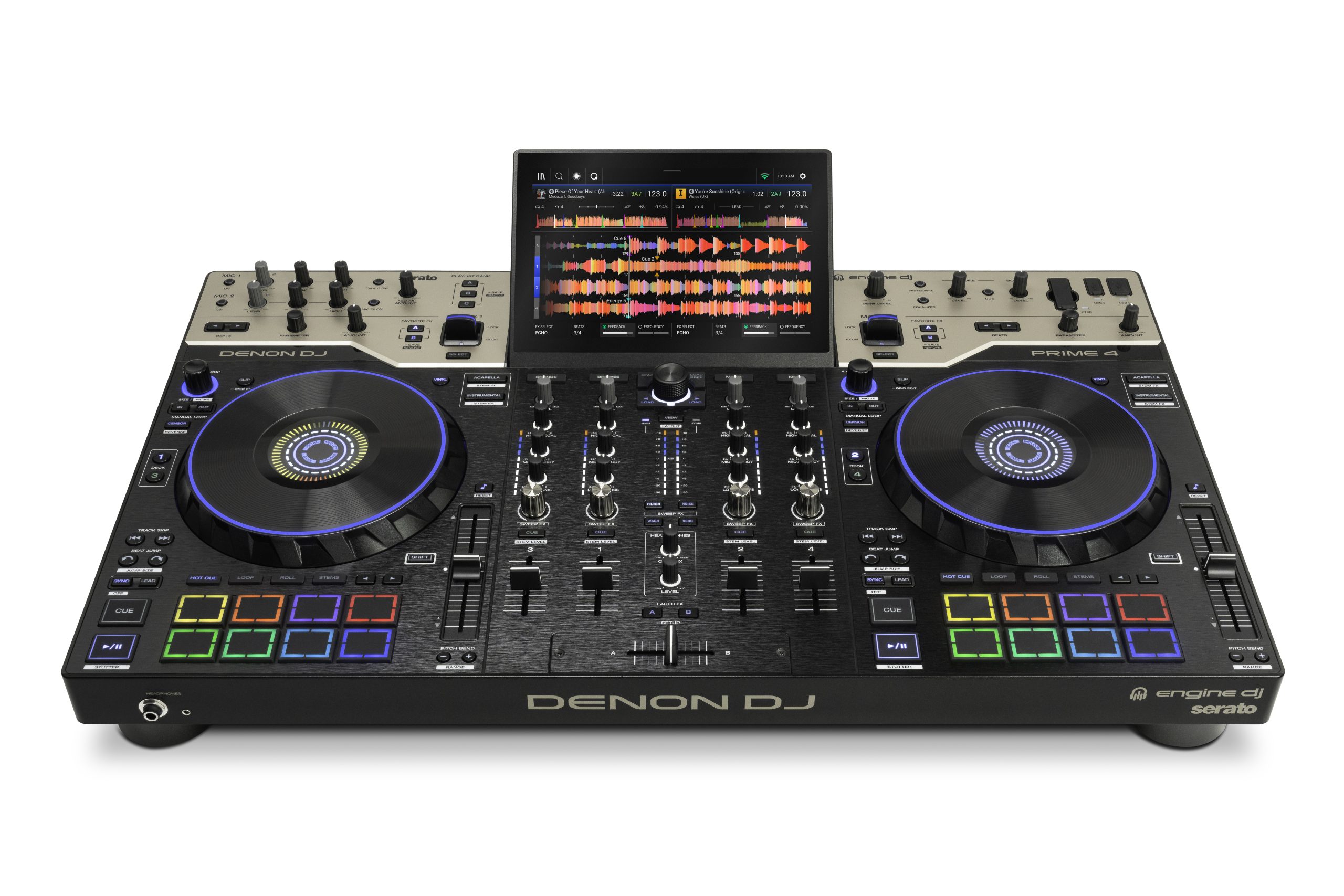
With four times the processing power of the original PRIME 4, onboard Stems rendering, full-size 8-inch jog wheels, and the first MPCe multi-zone pads on DJ hardware, the PRIME 4 G2 brings substantial hardware and workflow upgrades to the platform.
For DJs who want one centerpiece capable of handling both creative performance and the practical demands of real-world events, a new level of standalone DJ performance has been achieved.
Shop the Denon DJ PRIME 4 G2 at AGIProDJ
Four X the Processing Power
One of the most important upgrades is not something you can see from across the room.
According to Denon DJ, the PRIME 4 G2 delivers four times the processing power of the previous PRIME 4, using an 8-core ARM processor with 4 GB of RAM. That extra horsepower supports faster library navigation, a more responsive operating experience, and onboard Stems rendering.
That last part matters.
Tracks can be prepared for four-part Stems ahead of time using Engine DJ desktop, or they can be rendered directly on the PRIME 4 G2. DJs can queue individual tracks, multiple songs, or playlists for Stem processing while continuing to perform.
That extra processing power changes what the G2 can actually do in standalone mode.
MPCe Pads Bring Something New to DJ Hardware
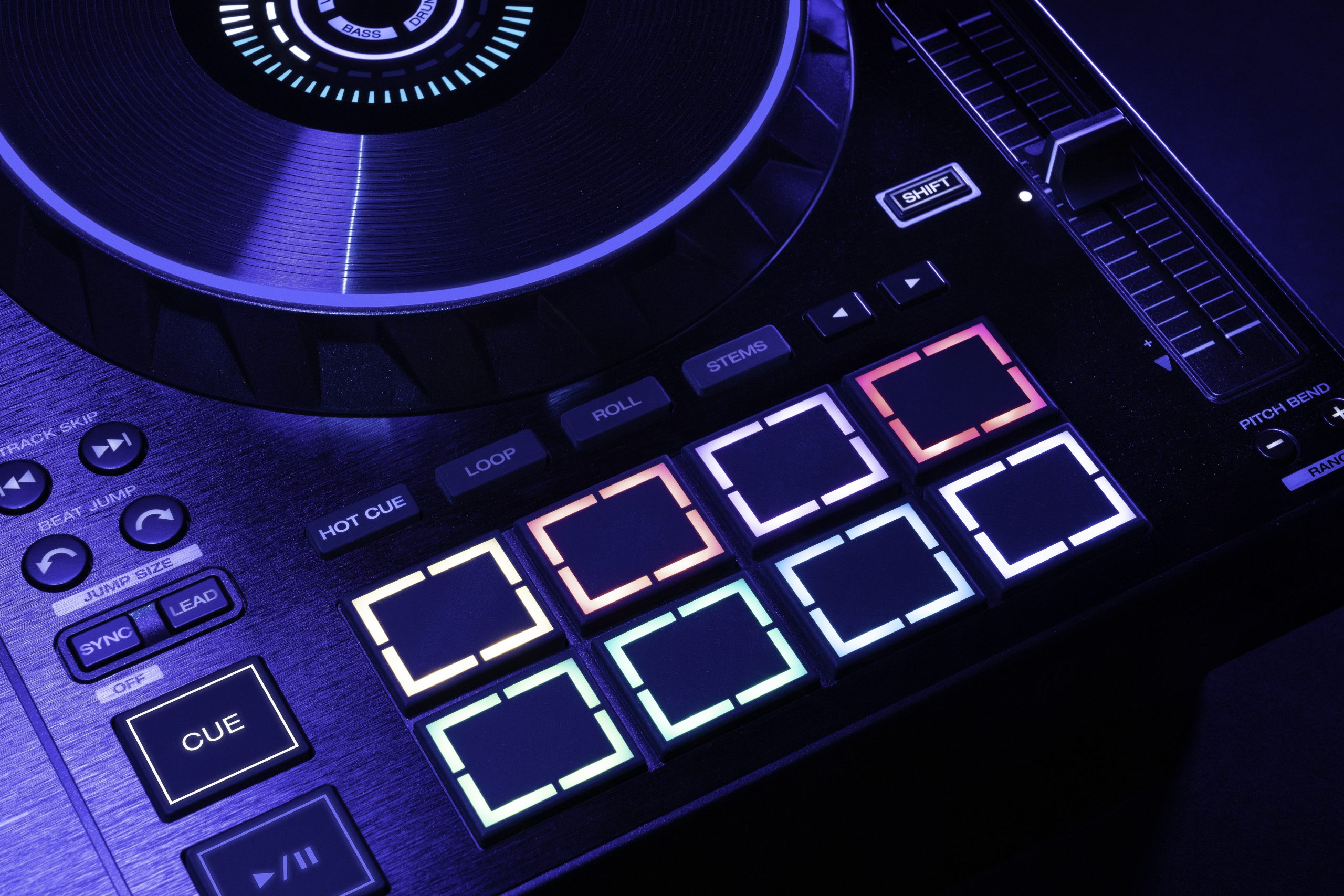
The headline performance feature may be the new MPCe multi-zone performance pads.
The PRIME 4 G2 includes 16 velocity- and pressure-sensitive pads with 3D sensing technology. Rather than treating the entire pad as one trigger, MPCe modes can divide a pad into multiple zones and combine different functions or parameters within a single control.
That opens up modes including Filter Roll, Auto Loop Stems, Hot Cue Stems, Hot Cue Roll, XY FX, Roll FX, and Engine Lighting performance controls.
For example, Auto Loop Stems can combine loop creation with an Instrumental or Acapella action from the same pad. Hot Cue Stems can trigger a cue point while simultaneously changing which Stem elements are active.
That is where the MPCe concept starts to make sense. Instead of simply adding more pad modes, Denon DJ is giving DJs ways to combine multiple performance actions into a single move.
What Mojaxx Thought of the New Pads

In his Beatport Tech hands-on review, Mojaxx spent considerable time exploring the MPCe workflow rather than simply running through the pad modes.
His takeaway was especially positive when the pads combined several actions into one move. He also highlighted their potential for Engine Lighting users, where multiple lighting parameters can be available directly from the performance pads. He described the implementation as a “great use of technology.” Watch Beatport Tech Review
There is a learning curve. Mojaxx noted that DJs need to get accustomed to where each zone responds on the pad. However, once that interaction becomes familiar, the system gives you considerably more control from the same physical space.
Stems Get Dedicated Hardware Control
Stems are no longer just another pad mode on the PRIME 4 G2.
Dedicated Acapella and Instrumental buttons let DJs quickly isolate vocals or instrumental elements. Traditional Stems pad control remains available as well, along with Stem FX.
There is also Stem Level EQ.
Hold Shift and press the channel Cue control, and the channel EQ section switches from traditional frequency control to Stem level adjustment. High controls the Vocal Stem, Mid handles Melody and Bass together, and Low controls Drums. The system uses soft takeover when switching functions so knob positions do not cause abrupt level changes.
The jog-wheel displays also show active Stem elements, providing another visual reference without requiring you to stay focused on the main screen.
That makes Stems feel much more like part of the mixer rather than a feature buried inside the software.
Bigger 8-Inch Jog Wheels
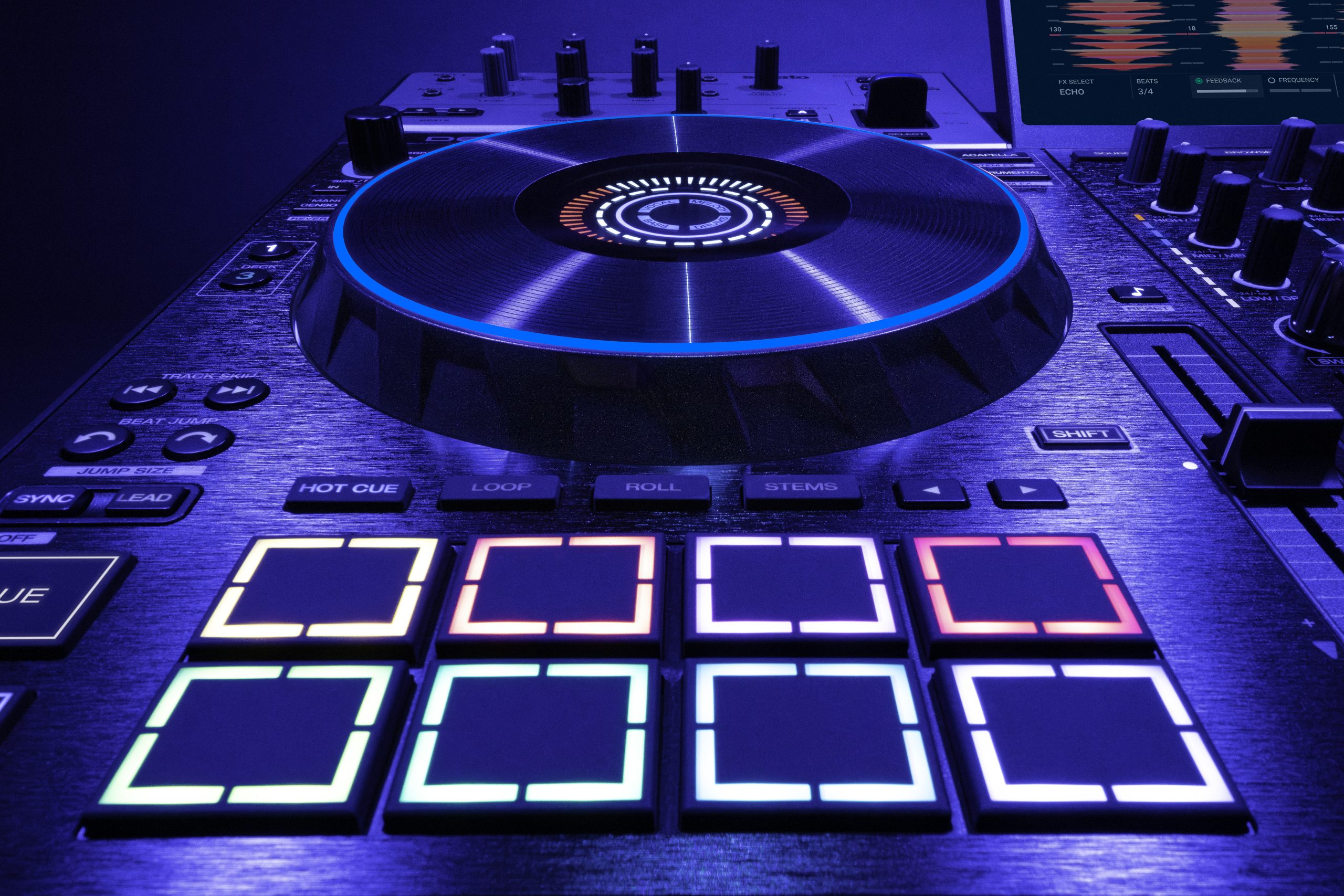
Visually, one of the easiest ways to identify the PRIME 4 G2 is its new 8-inch capacitive jog wheels.
The larger platters are more than a visual upgrade. Early hands-on feedback has been especially positive about their responsiveness, smooth spinbacks, and more refined feel compared with previous PRIME 4 models.
The center displays provide useful performance information too. DJs can see track progress, playhead position, deck status, active Stem elements, and Hot Cue information.
The Hot Cue Countdown is particularly clever. As an upcoming cue approaches, the outer LED ring fills with the cue’s assigned color and reaches the top as playback arrives at that point.
An FX Section You Can Really Dig Into
Denon DJ has also overhauled the effects workflow.
The PRIME 4 G2 features two assignable Main FX modules with more than 25 effects, physical toggle paddles, parameter controls, and Favorite FX buttons. Pull a paddle toward you for a momentary effect or push it away to latch the effect on.
Those Main FX sit alongside:
- 10 touchscreen Touch FX
- Four channel Sweep FX
- Fader FX controlled through channel faders or the crossfader
- MPCe XY FX
- MPCe Roll FX
- Stem FX
Favorite FX can also retain their settings after the PRIME 4 G2 powers down. DJs can choose whether Favorite FX mirror across the decks or remain independently assigned.
The new paddle layout makes the effects workflow more immediate than on previous PRIME 4 models, while the sheer number of FX options gives DJs plenty of room to go deeper.
Built-In DMX Makes Engine Lighting Even More Useful
For mobile DJs, this may be one of the most practical changes.
The PRIME 4 G2 includes a physical 3-pin DMX output for its onboard Engine Lighting system powered by SoundSwitch. DJs can connect the G2 directly to compatible DMX lighting without needing a separate DMX interface for a basic one-universe setup.
The built-in interface supports one universe with up to 512 channels.
Even better, the MPCe pads can control Engine Lighting functions including color, position, strobe, intensity, auto loops, and static looks.
DJs who normally perform on two decks could leave another deck selected for dedicated SoundSwitch pad controls. Switch decks, and an entire bank of lighting controls can immediately sit under your fingers.
That combination of standalone audio and lighting control feels very specifically aimed at working mobile DJs.

The Output Section Is Built for Events
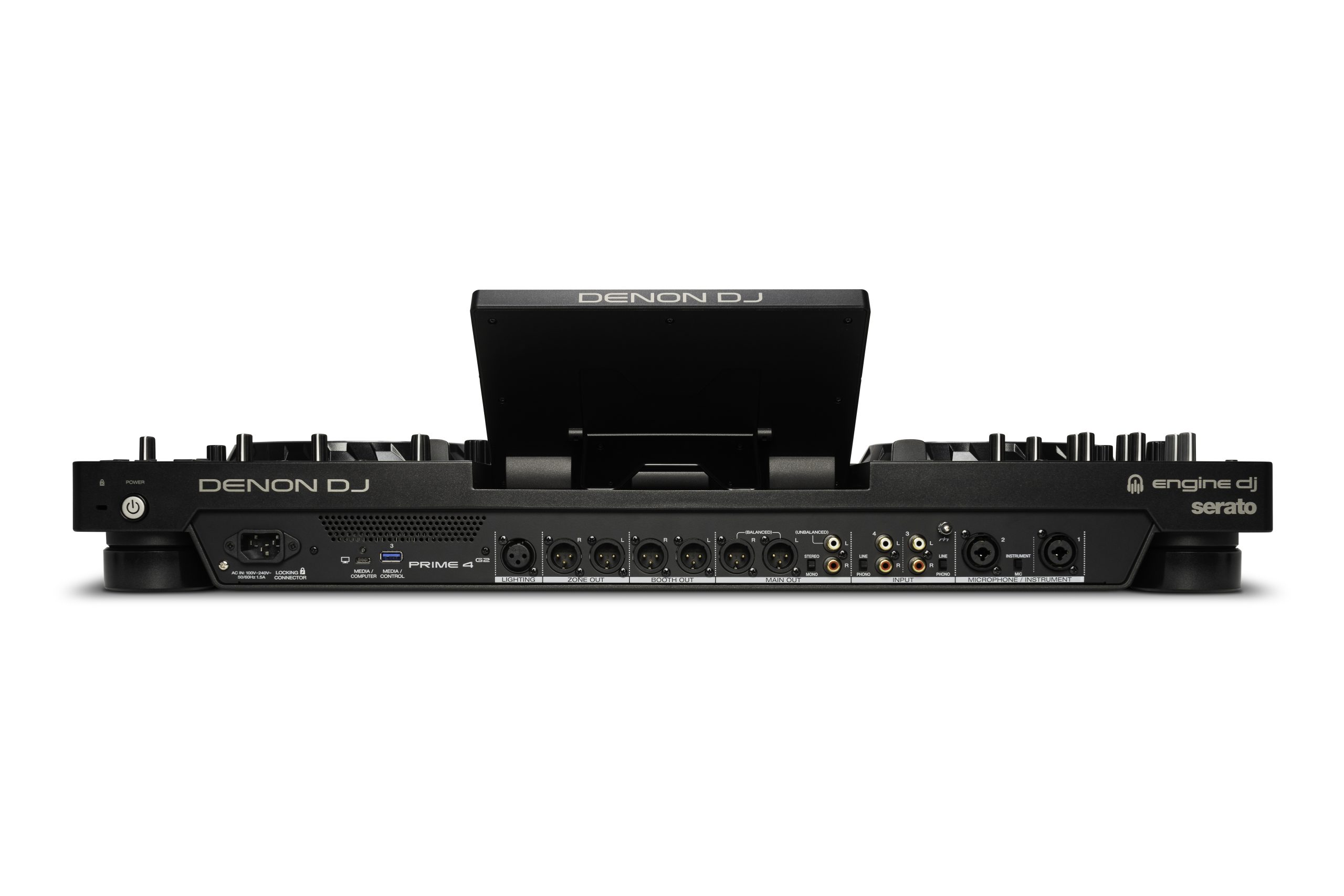
The rear panel reinforces the PRIME 4 G2’s focus on working and event DJs.
The PRIME 4 G2 provides balanced XLR Main, Booth, and Zone outputs, plus an RCA Main output. Each of the three primary output sections has its own level control.
The Zone output can send an individual channel, the Main mix, or playlist content to a separate audio system. A dedicated Zone Cue function and on-screen 10-band EQ for the Main, Booth, and Zone outputs add even more control.
For wedding and event DJs, that routing flexibility makes it easier to manage cocktail areas, patios, secondary rooms, or other audio zones from the same console. It is an unusually comprehensive output section for an all-in-one DJ system.
Connectivity continues with two Line/Phono RCA inputs, two XLR/TRS microphone inputs, USB-A and USB-C ports, an SD card slot, and an internal 2.5-inch SATA drive bay. Mic 2 can also switch to instrument-level operation, giving DJs another option for connecting an external audio source.
Streaming That Accounts for Real-World Wi-Fi
Built-in Wi-Fi gives DJs access to supported streaming and cloud sources directly through Engine DJ.
There is also some useful engineering happening behind the scenes. When a streaming track loads, the PRIME 4 G2 analyzes it for BPM and key and buffers the track into internal memory. That buffering helps protect playback if the Wi-Fi connection briefly drops during a set.
That is exactly the kind of feature that matters more at a real event than it does on a spec sheet.
Three dedicated Playlist Bank buttons also provide instant access to frequently used playlists. Assign a playlist to one of the three banks, and you can jump back to it without repeatedly navigating through your library—a small workflow feature that can become very useful during a long event.
OmniSource Could Be a Major Upgrade—But It Is Still Coming
The PRIME 4 G2 also introduces OmniSource architecture, designed to bring standalone and software-based DJing into the same workflow.
With OmniSource, DJs will be able to move between Engine DJ media, streaming sources, and compatible computer or mobile DJ software without the disruptive mode changes required by previous PRIME 4 hardware.
For existing PRIME 4 and PRIME 4 Plus owners, that could become one of the G2’s most meaningful upgrades. There will always be situations where a DJ who normally works standalone needs access to laptop or mobile DJ software, and seamless switching between those environments adds another level of flexibility.
There is one important catch: OmniSource software support is still coming. Compatibility with Serato DJ Pro, VirtualDJ, and Algoriddim djay is planned for future updates.
The potential is significant, but the full value of OmniSource will become clearer as those software integrations arrive.
PRIME 4 G2 Key Specifications
| Specification | Denon DJ PRIME 4 G2 |
|---|---|
| Channels / Decks | 4-channel / 4-deck standalone |
| Display | 10.1-inch, 1280 × 800 multi-touch |
| Jog Wheels | 8-inch capacitive |
| Performance Pads | 16 MPCe velocity and pressure-sensitive |
| Processor | 8-core ARM |
| RAM | 4 GB |
| DAC | ESS ES9017S 32-bit |
| Main Output | Balanced XLR + RCA |
| Booth Output | Balanced XLR |
| Zone Output | Balanced XLR |
| Microphone Inputs | 2 × XLR / 1/4-inch combo |
| Line/Phono Inputs | 2 stereo RCA sets |
| Wi-Fi | 2.4 / 5 GHz |
| Bluetooth | Bluetooth 5.4 |
| Internal Storage | 2.5-inch SATA drive bay |
| DMX | Built-in, 1 universe / 512 channels |
| Weight | 21.83 lbs. / 9.9 kg |
| Dimensions | 30 × 19.57 × 4.13 inches |
Who Is the PRIME 4 G2 Really For?
The PRIME 4 G2 has plenty to interest performance-focused DJs, but its strongest identity may still be as the centerpiece of a mobile or private-event DJ system.
Four standalone decks, dual microphone inputs, independent Zone output, XLR connectivity, onboard lighting control, internal storage, streaming, Stems, and deep library management all address jobs that working event DJs deal with regularly.
At the same time, Denon DJ has made the creative side considerably stronger. The larger jog wheels, MPCe pads, Stem controls, and redesigned FX section mean the G2 is not simply a utility-focused event console.
It is designed to perform too.
More Than a PRIME 4 Refresh
The PRIME 4 Plus refined a platform DJs already knew.
The PRIME 4 G2 feels like Denon DJ asking what the next version of that platform should actually become.
More processing power makes Engine DJ faster and enables onboard Stems rendering. MPCe pads introduce new performance possibilities. Larger jog wheels improve the hands-on experience. Built-in DMX takes Engine Lighting another step forward, while the XLR Main, Booth, and Zone architecture remains squarely focused on professional event work.
Taken together, those upgrades make the PRIME 4 G2 more than a collection of new features. They create a standalone system that can handle creative performance, music management, lighting control, and the practical routing demands of a real event from one centerpiece.
For DJs who want one standalone system at the center of both their performance and event-production workflow, the PRIME 4 G2 makes a compelling case for what the next generation of standalone DJ performance should look like.
Shop the Denon DJ PRIME 4 G2 at AGIProDJ
FAQs
What is the Denon DJ PRIME 4 G2?
The PRIME 4 G2 is a four-channel, four-deck standalone DJ system powered by Engine DJ. It combines standalone playback, Stems, effects, streaming, professional audio routing, and lighting control in one console.
What are the biggest upgrades from the previous PRIME 4?
Major changes include four times the processing power, 8-inch jog wheels, MPCe multi-zone pads, onboard Stems rendering, dedicated Stem controls, redesigned FX, upgraded faders, and a built-in DMX output.
Can the PRIME 4 G2 render Stems without a computer?
Yes. Tracks can be rendered for four-part Stems directly on the PRIME 4 G2. DJs can also continue performing while Stem processing runs in the background.
Does the PRIME 4 G2 have separate Main, Booth, and Zone outputs?
Yes. Main, Booth, and Zone all use balanced XLR outputs. The Zone section also provides independent routing and control for a secondary audio system.
Does the PRIME 4 G2 have built-in DMX lighting control?
Yes. A built-in 3-pin DMX output works with Engine Lighting powered by SoundSwitch. The internal interface supports one DMX universe with up to 512 channels.